
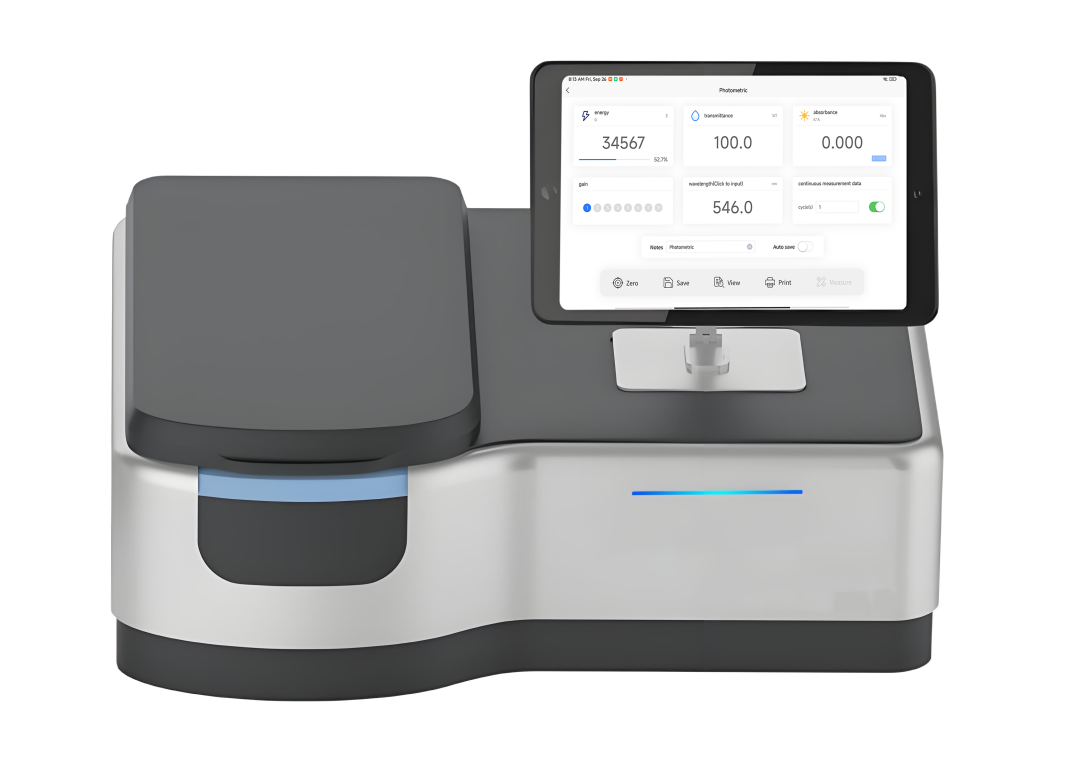
M Series Spectrophotometer
Eight spectrophotometers from M300 to M601S. The M300 is a visible-range model (320–1100 nm, tungsten lamp); the other seven cover 190–1100 nm. Optical design and spectral bandwidth vary by model.
Documentation
Datasheets and manuals are issued per model and revision. Ask for the documents that match the configuration you are considering.
See linked documents| Wavelength Accuracy | ±0.1 nm at 656.1 nm; ±0.3 nm across the specified wavelength range |
|---|---|
| Wavelength Repeatability | ≤0.1 nm |
| Photometric Accuracy | ±0.2%T(0~100%T), ±0.0005A(0-0.5A), ±0.0008A(0.5-1A) |
Send your sample type and method, and we will confirm the configuration and current lead time.
Ask about this modelModel comparison
M Series Spectrophotometer range at a glance
Full specifications for every model in the series, side by side. Tell us the sample type and throughput you need and we will point to the closest configuration.
| Parameter | M300 | M500 | M501 | M501S | M400 | M600 | M601 | M601S |
|---|---|---|---|---|---|---|---|---|
| Optical System | Single Beam, Grating 1200 lines/mm | Single Beam, Grating 1200 lines/mm | Single Beam, Grating 1200 lines/mm | Single Beam, Grating 1200 lines/mm | Split Beam, Grating 1200 lines/mm | Double Beam, Grating 1200 lines/mm | Double Beam, Grating 1200 lines/mm | Double Beam, Grating 1200 lines/mm |
| Wavelength Range | 320-1100 nm | 190-1100 nm | 190-1100 nm | 190-1100 nm | 190-1100 nm | 190-1100 nm | 190-1100 nm | 190-1100 nm |
| Spectral Bandwidth | 2 nm | 2 nm | 1 nm | 0.5/1/2/4/5 nm | 2 nm | 2 nm | 1 nm | 0.5/1/2/4/5 nm |
| Wavelength Accuracy | ±0.1 nm at 656.1 nm; ±0.3 nm across the specified wavelength range | ±0.1 nm at 656.1 nm; ±0.3 nm across the specified wavelength range | ±0.1 nm at 656.1 nm; ±0.3 nm across the specified wavelength range | ±0.1 nm at 656.1 nm; ±0.3 nm across the specified wavelength range | ±0.1 nm at 656.1 nm; ±0.3 nm across the specified wavelength range | ±0.1 nm at 656.1 nm; ±0.3 nm across the specified wavelength range | ±0.1 nm at 656.1 nm; ±0.3 nm across the specified wavelength range | ±0.1 nm at 656.1 nm; ±0.3 nm across the specified wavelength range |
| Wavelength Repeatability | ≤0.1 nm | ≤0.1 nm | ≤0.1 nm | ≤0.1 nm | ≤0.1 nm | ≤0.1 nm | ≤0.1 nm | ≤0.1 nm |
| Photometric Accuracy | ±0.2%T(0~100%T), ±0.0005A(0-0.5A), ±0.0008A(0.5-1A) | ±0.2%T(0~100%T), ±0.0005A(0-0.5A), ±0.0008A(0.5-1A) | ±0.2%T(0~100%T), ±0.0005A(0-0.5A), ±0.0008A(0.5-1A) | ±0.2%T(0~100%T), ±0.0005A(0-0.5A), ±0.0008A(0.5-1A) | ±0.2%T(0~100%T), ±0.0005A(0-0.5A), ±0.0008A(0.5-1A) | ±0.2%T(0~100%T), ±0.0005A(0-0.5A), ±0.0008A(0.5-1A) | ±0.2%T(0~100%T), ±0.0005A(0-0.5A), ±0.0008A(0.5-1A) | ±0.2%T(0~100%T), ±0.0005A(0-0.5A), ±0.0008A(0.5-1A) |
| Photometric Repeatability | ≤0.15%T (0-100%T), 0.0004A(0-0.5A), 0.0006A(0.5-1A) | ≤0.15%T (0-100%T), 0.0004A(0-0.5A), 0.0006A(0.5-1A) | ≤0.15%T (0-100%T), 0.0004A(0-0.5A), 0.0006A(0.5-1A) | ≤0.15%T (0-100%T), 0.0004A(0-0.5A), 0.0006A(0.5-1A) | ≤0.15%T (0-100%T), 0.0004A(0-0.5A), 0.0006A(0.5-1A) | ≤0.15%T (0-100%T), 0.0004A(0-0.5A), 0.0006A(0.5-1A) | ≤0.15%T (0-100%T), 0.0004A(0-0.5A), 0.0006A(0.5-1A) | ≤0.15%T (0-100%T), 0.0004A(0-0.5A), 0.0006A(0.5-1A) |
| Photometric Range | 0-400%T, -4~4A | 0-400%T, -4~4A | 0-400%T, -4~4A | 0-400%T, -4~4A | 0-400%T, -4~4A | 0-400%T, -4~4A | 0-400%T, -4~4A | 0-400%T, -4~4A |
| Resolution | 0.00001Abs | 0.00001Abs | 0.00001Abs | 0.00001Abs | 0.00001Abs | 0.00001Abs | 0.00001Abs | 0.00001Abs |
| Stray Light | ≤0.03%T@220 nm, 360 nm | ≤0.03%T@220 nm, 360 nm | ≤0.03%T@220 nm, 360 nm | ≤0.03%T@220 nm, 360 nm | ≤0.03%T@220 nm, 360 nm | ≤0.03%T@220 nm, 360 nm | ≤0.03%T@220 nm, 360 nm | ≤0.03%T@220 nm, 360 nm |
| Stability | ±0.0001A | ±0.0001A | ±0.0001A | ±0.0001A | ±0.0001A | ±0.0001A | ±0.0001A | ±0.0001A |
| Baseline Flatness | ±0.0004A | ±0.0004A | ±0.0004A | ±0.0004A | ±0.0004A | ±0.0004A | ±0.0004A | ±0.0004A |
| Noise | 0.0005A@500 nm | 0.0005A@500 nm | 0.0005A@500 nm | 0.0005A@500 nm | 0.0005A@500 nm | 0.0005A@500 nm | 0.0005A@500 nm | 0.0005A@500 nm |
| Work Mode | T, A, C, E | T, A, C, E | T, A, C, E | T, A, C, E | T, A, C, E | T, A, C, E | T, A, C, E | T, A, C, E |
| Scanning Speed | Hi, Med, Low (Max. 8000 nm/min) | Hi, Med, Low (Max. 8000 nm/min) | Hi, Med, Low (Max. 8000 nm/min) | Hi, Med, Low (Max. 8000 nm/min) | Hi, Med, Low (Max. 8000 nm/min) | Hi, Med, Low (Max. 8000 nm/min) | Hi, Med, Low (Max. 8000 nm/min) | Hi, Med, Low (Max. 8000 nm/min) |
| Display | 11-inch Touchscreen | 11-inch Touchscreen | 11-inch Touchscreen | 11-inch Touchscreen | 11-inch Touchscreen | 11-inch Touchscreen | 11-inch Touchscreen | 11-inch Touchscreen |
| Light Source | Tungsten Lamp | Deuterium & Tungsten Lamp | Deuterium & Tungsten Lamp | Deuterium & Tungsten Lamp | Deuterium & Tungsten Lamp | Deuterium & Tungsten Lamp | Deuterium & Tungsten Lamp | Deuterium & Tungsten Lamp |
| Detector | Silicon Photodiode | Silicon Photodiode | Silicon Photodiode | Silicon Photodiode | Silicon Photodiode | Silicon Photodiode | Silicon Photodiode | Silicon Photodiode |
| Cuvette Holder | 10 mm manual 4-cell holder | 10 mm manual 4-cell holder | 10 mm manual 4-cell holder | 10 mm manual 4-cell holder | 10 mm manual 4-cell holder | 10 mm single hole cell holder | 10 mm single hole cell holder | 10 mm single hole cell holder |
| Output | Cloud connectivity/Email/SMS/Bluetooth/Wi-Fi | Cloud connectivity/Email/SMS/Bluetooth/Wi-Fi | Cloud connectivity/Email/SMS/Bluetooth/Wi-Fi | Cloud connectivity/Email/SMS/Bluetooth/Wi-Fi | Cloud connectivity/Email/SMS/Bluetooth/Wi-Fi | Cloud connectivity/Email/SMS/Bluetooth/Wi-Fi | Cloud connectivity/Email/SMS/Bluetooth/Wi-Fi | Cloud connectivity/Email/SMS/Bluetooth/Wi-Fi |
| Power | AC 110-220V 50-60 Hz | AC 110-220V 50-60 Hz | AC 110-220V 50-60 Hz | AC 110-220V 50-60 Hz | AC 110-220V 50-60 Hz | AC 110-220V 50-60 Hz | AC 110-220V 50-60 Hz | AC 110-220V 50-60 Hz |
Shaded labels mark the specifications that differ between models.
Overview
What this instrument measures, and how it fits the range.
The M Series Spectrophotometer covers 8 models, M300 to M601S. The M300 is a visible-range instrument covering 320–1100 nm with a tungsten lamp; the other seven models cover 190–1100 nm with deuterium and tungsten lamps. Optical systems differ across the range: single beam (M300 to M501S), split beam (M400) and double beam (M600 to M601S). Spectral bandwidth is 2 nm, 1 nm or 0.5/1/2/4/5 nm depending on model, and the comparison table lists every value side by side.
Key points
- 11-inch Touchscreen
- Functions include photometric measurement, quantitative analysis, kinetics, wavelength scanning, DNA/protein analysis and multi-wavelength measurement.
- Equipped with GLP/GMP functions, including user management, audit trails and log review, etc.
- Supports real-time data transmission via email and SMS.
- Bluetooth 3.0 connectivity within the specified operating range.
- Connects directly to a compatible laser printer via Wi-Fi or a compatible thermal printer via Bluetooth.
- Extensive accessories are optional, such as auto 4-cell/5-cell/8-cell holder, film holder, tube rack, integrating sphere, reflection accessory, Peltier temperature-control / sipper system, 21 CFR compliant software, etc.
Full specifications for this model are listed at the top of this page.
Accessories
Confirm these items before the final quotation. Accessories are listed only where the manufacturer offers them.
Standard accessories
- 10mm glass cuvette x 4
- 10mm quartz cuvette(UV) x 2
- Power cord
- User manual
Optional accessories
- auto 4-cell/5-cell/8-cell holder
- film holder
- tube rack
- integrating sphere
- reflection accessory
- Peltier temperature-control / sipper system
- 21 CFR compliant software
Product documentation
- Brochure Yoke product guide Download
- Selection guide Prepare a UV-Vis purchase brief v1.0 Learn more
Common selection questions
Confirm requirements with our team before the final order.
Which of the eight M Series models should I choose?
The range runs from M300 to M601S. The M300 covers 320–1100 nm with a tungsten lamp; the other seven models cover 190–1100 nm with deuterium and tungsten lamps. Optical design differs: M300 to M501S are single beam, M400 is split beam, and M600 to M601S are double beam. All eight share ±0.1 nm wavelength accuracy at 656.1 nm (±0.3 nm across the range) and an 11-inch touchscreen. Photometric accuracy is ±0.0005 A from 0 to 0.5 A and ±0.0008 A from 0.5 to 1 A. The step up between models buys optical design, spectral bandwidth and scanning speed, so match the model to the methods you actually run.
Is 8,000 nm/min fast enough for scanning?
For routine survey scans across 190–1100 nm, yes — a full-range scan takes roughly eight seconds at that speed. If you scan narrow regions repeatedly the practical limit is the spectral resolution and sampling interval you set, not the drive speed.
What does cloud connectivity mean in practice?
Results can be pushed to a cloud account over the network, and the same instrument also offers e-mail, SMS, Bluetooth and Wi-Fi. Most laboratories keep USB export as the controlled record and use the network path for remote review rather than for archiving.
Let’s talk about your application
Find the right instrument for your application
Share your sample, measurement requirements and preferred configuration.