
October 12, 2026
Choosing a UV-Vis Platform for International QC Workflows
A method-first guide to wavelength, sample handling, data and service when selecting a UV-Vis spectrophotometer for an export QC workflow.
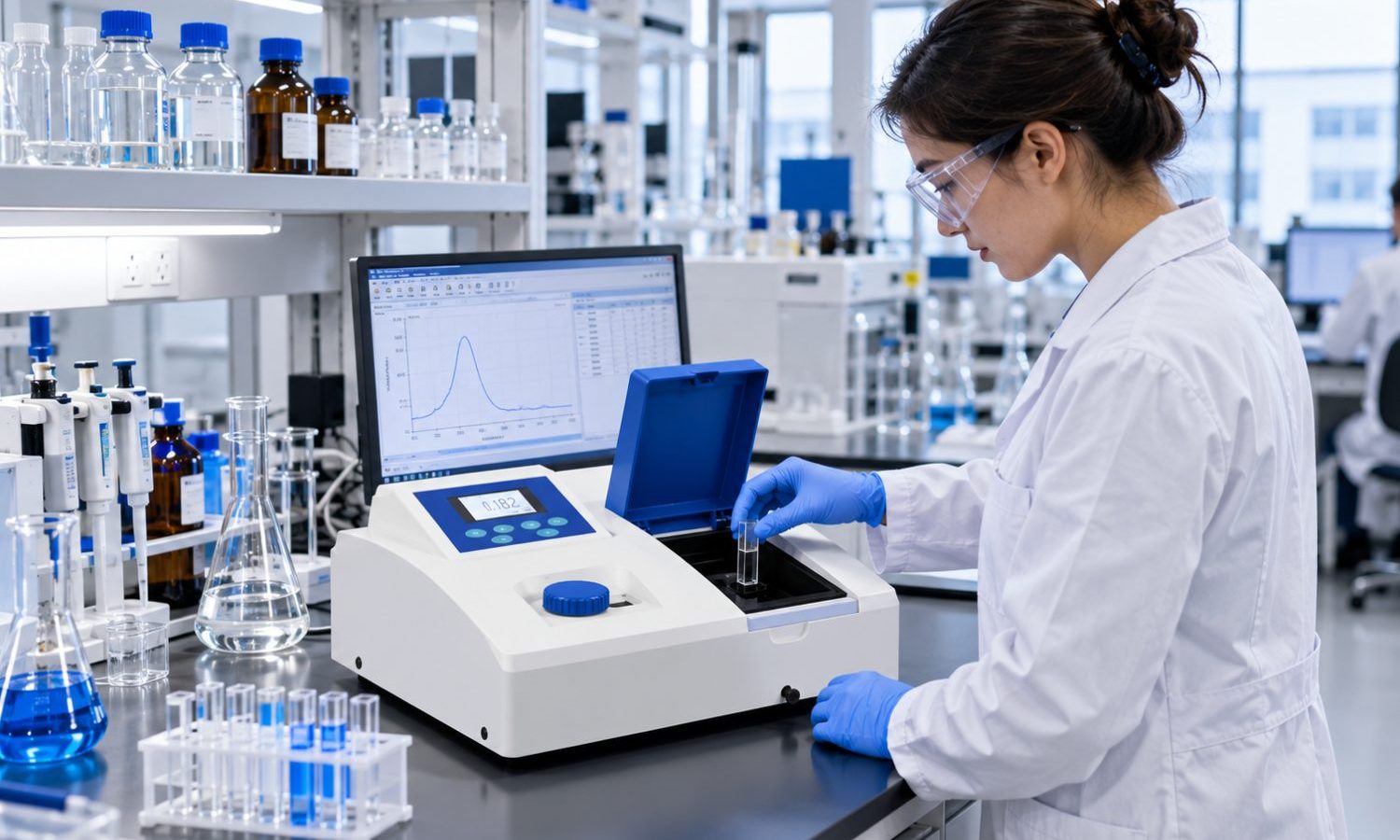
UV-Vis is often the first instrument a QC laboratory buys and the last one it replaces. That makes the selection question less about today’s method than about the methods the laboratory will add over the next five years — and less about the wavelength range than about what the instrument holds constant while a method runs.
Start from the method, not the range
Define the working wavelength and absorbance range first. Compare performance at those operating points as well as the instrument’s full wavelength range.
Four specification points that matter
- Wavelength accuracy at the working wavelength, and how it is verified in the field.
- Photometric accuracy and stray light across the absorbance range actually used, because stray light sets the usable upper limit.
- Baseline stability over the length of a run, which decides whether a long batch drifts into a trend.
- Spectral bandwidth, which decides whether two closely spaced maxima can be resolved at all.
Sample handling and accessories
Cells, cell changers, sippers, temperature control and microvolume sampling are not accessories in the commercial sense; they define what the platform can measure. A laboratory that runs turbid or colored samples needs a cell path and a blank strategy that a clean-sample laboratory does not. A laboratory with limited sample volume needs a microvolume option, which is cheap at the point of order and awkward to add later.
The comparison that decides it
| Requirement | Question to ask | Why |
|---|---|---|
| Routine fixed-wavelength work | Is the working wavelength verified in the field? | A drift of a nanometre is invisible in the result and real in the method |
| Scanning and identification | What is the scan speed and bandwidth? | Resolution decides whether a shoulder can be seen at all |
| High absorbance | Stray light at the working wavelength | Sets the ceiling of the usable range |
| Long batches | Baseline stability over time | Drift becomes a trend across the batch |
| Small volumes | Microvolume or short-path options | Sample availability often decides the method |
Data and service in an export context
Confirm the raw-data export format and the available local services for wavelength and photometric verification. Include any return-to-factory requirements and expected turnaround times in the support plan.
Matching the platform to the laboratory
A teaching laboratory needs robustness, a simple interface and a wavelength set that covers its reagents. A routine QC laboratory needs a stable baseline, dependable photometrics and a short path from sample to record. A method-development laboratory needs scanning, bandwidth options and data export above all. Three laboratories, three different answers, and the same model is rarely right for all three.
Source notes
This article is an editorial summary for international buyers. Review the current source and confirm model specific details with Yoke before purchase: the Yoke spectroscopy product range.
Let’s talk about your application
Questions about this topic?
Our application team can review your method and the configuration that fits it.